
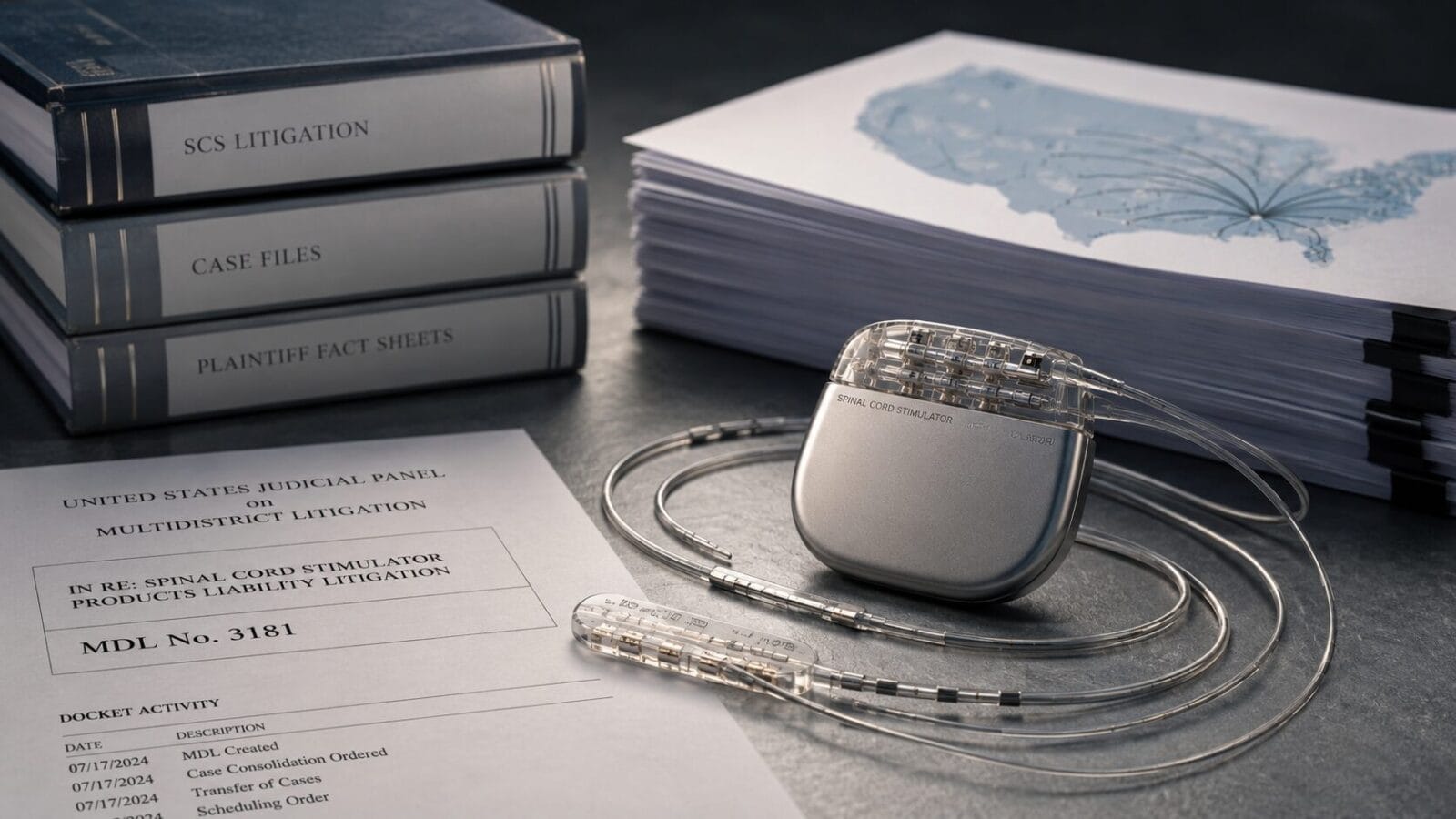
The U.S. Judicial Panel on Multidistrict Litigation has created a new MDL for Boston Scientific spinal cord stimulator products liability cases, but the order is narrower than some plaintiffs requested.
In MDL No. 3181, the Panel centralized Boston Scientific spinal cord stimulator actions in the Central District of California before Judge Josephine L. Staton. Importantly, the Panel declined to create a broader, industry-wide spinal cord stimulator MDL that would include Abbott, Nevro, Medtronic, and other manufacturers.
That distinction matters for plaintiff firms evaluating this litigation, planning intake, and deciding how to communicate with potential claimants.
What the JPML actually did
The transfer order involved lawsuits alleging injuries from surgically implanted spinal cord stimulator devices. Plaintiffs sought centralization of actions involving Boston Scientific and Abbott, while some responding plaintiffs urged the Panel to expand the proceeding to include Nevro and potentially other manufacturers.
The Panel rejected that broader approach. It found that an industry-wide MDL was not appropriate because each manufacturer has its own product lines, regulatory history, discovery issues, and potentially confidential or trade-secret materials.
Instead, the JPML centralized the Boston Scientific cases only and renamed the litigation:
In re Boston Scientific Corporation Spinal Cord Stimulator Products Liability Litigation
Why Abbott was not included
Abbott remains relevant background, but it is not part of the newly centralized MDL based on this order.
The Panel listed four Abbott cases on Schedule B, all pending in the Northern District of Illinois, and expressly denied centralization as to those actions. The Panel also noted that denial now does not necessarily foreclose future centralization if circumstances change.
For law firms, this means marketing and intake language should be precise. A campaign should not describe the new MDL as an “all spinal cord stimulator manufacturer” proceeding. The stronger and safer framing is that JPML created a Boston Scientific-specific MDL while leaving Abbott and other manufacturers outside the centralized proceeding for now.
What allegations are at issue
According to the JPML order, the Boston Scientific actions share factual questions involving allegations that Boston Scientific failed to comply with regulatory requirements for Class III medical devices, including allegations related to the PMA approval and PMA supplement process. Plaintiffs also allege failures to warn and concealment of known risks.
The order identifies alleged injuries including unsatisfactory pain relief, shocking, burning, lead migration, autonomic dysfunction, and neurological injuries.
Those allegations are unproven at this stage. But for plaintiff firms, the centralization creates a clearer procedural structure for tracking the litigation, evaluating claimant criteria, and monitoring how common factual issues develop.
Why this matters for plaintiff-firm intake
A new MDL often creates increased public attention. That can lead to more search activity, more claimant inquiries, and more competition among firms trying to reach qualified prospective clients.
But this order also shows why precision matters.
For spinal cord stimulator campaigns, intake teams should distinguish between:
- Boston Scientific device claimants potentially connected to MDL No. 3181
- Abbott device claimants outside the MDL for now
- Nevro, Medtronic, or other device claimants who may raise similar concerns but are not included in this centralized proceeding
- Claimants with uncertain manufacturer information who need careful screening before any case evaluation
The firms that handle this distinction clearly will be better positioned to avoid overbroad advertising claims, reduce intake waste, and route potential claimants more accurately.
What plaintiff firms should watch next
The most important next developments will likely include transfer activity, potential tag-along cases, early case-management orders, leadership structure, motion practice, and any future centralization efforts involving Abbott or other manufacturers.
Firms should also watch whether claimant criteria become more defined around device model, implant date, revision or explant history, alleged injury type, and medical documentation.
At SmashOrbit Legal, we help plaintiff firms translate developments like this into precise, ethical, and performance-driven client acquisition strategy. We combine decades of plaintiffs-firm and Fortune 500 advertising experience with AI-supported analysis to refine channels, improve campaign quality, and help firms pursue more consistent volume of higher-qualified claimants.
Want to learn more about spinal cord stimulator litigation marketing strategy? Message us to see how we can help grow your firm with clearer targeting, stronger intake alignment, and transparent campaign optimization.