
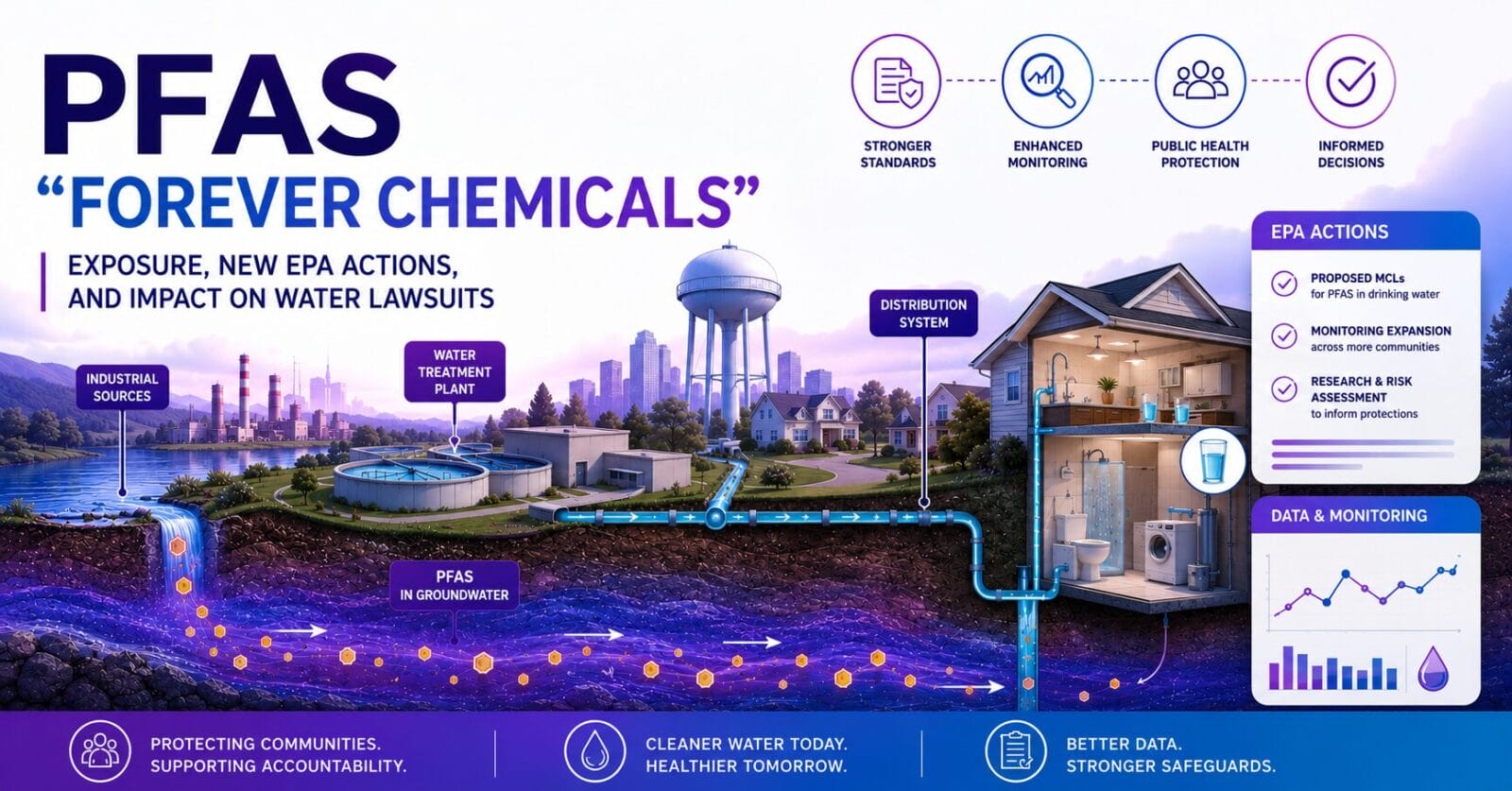
PFAS litigation continues to evolve quickly, and recent EPA actions are giving attorneys new regulatory benchmarks to evaluate water contamination claims. For law firms handling toxic exposure, environmental contamination, municipal water, or mass tort matters, the regulatory landscape around PFAS, commonly called “forever chemicals”, is no longer just background context. It may shape the way claims are investigated, valued, defended, and resolved.
EPA finalized the first national, legally enforceable drinking water standards for several PFAS in April 2024. The agency set enforceable Maximum Contaminant Levels of 4.0 parts per trillion for PFOA and PFOS, and 10 parts per trillion for PFHxS, PFNA, and GenX chemicals, while also creating a Hazard Index approach for certain PFAS mixtures. EPA stated that public water systems must complete initial monitoring by 2027 and implement solutions by 2029 if monitoring shows levels above the MCLs.
That rule is now part of a changing regulatory story. On May 18, 2026, EPA announced proposed rules that would keep the federal MCLs for PFOA and PFOS but allow qualifying drinking water systems to request two additional years, until 2031, to comply. EPA also proposed rescinding the drinking water regulations for PFHxS, PFNA, HFPO-DA/GenX, and the Hazard Index mixture of those PFAS plus PFBS, saying it intends to correct what it characterizes as procedural issues under the Safe Drinking Water Act.
For plaintiffs’ firms, the key takeaway is not simply that EPA has moved PFAS regulation forward, or that some standards are now under reconsideration. The more practical point is that EPA’s actions are expanding the evidentiary record around PFAS contamination while also creating new disputes over timing, compliance, exposure reduction, and who should pay for cleanup.
Why EPA’s PFAS actions matter to water contamination litigation
PFAS cases often turn on a familiar set of proof issues: source identification, exposure pathway, dose or concentration evidence, injury causation, remediation cost, and the defendant’s knowledge of risk. EPA’s recent PFAS activity can affect each of those categories.
First, the 2024 drinking water rule gives attorneys a federal benchmark for evaluating public water system data. A sample above 4.0 ppt for PFOA or PFOS may become especially important because those limits remain central to EPA’s current approach even as compliance timing is being reconsidered. Under EPA’s 2026 proposal, the PFOA and PFOS MCLs would remain 4.0 ppt, but some systems could receive a two-year extension to achieve compliance.
Second, EPA’s monitoring requirements may increase the availability of public data. The agency has required monitoring for PFAS through the Fifth Unregulated Contaminant Monitoring Rule, which covers 29 PFAS and lithium in public water systems, with sample collection occurring from 2023 to 2025. EPA has said the data improve understanding of the prevalence and amount of these contaminants in drinking water systems.
Third, attorneys should distinguish between regulatory compliance and civil liability. EPA expressly notes that UCMR 5 results do not themselves indicate compliance or noncompliance with the PFAS drinking water MCLs. That does not make the data irrelevant. Rather, it means lawyers may need to connect monitoring data to exposure windows, local water system history, source tracing, expert opinions, and applicable state-law theories.
CERCLA designation may strengthen cleanup and cost-recovery theories
EPA’s April 2024 CERCLA action is one of the most litigation-relevant developments for PFAS claims. EPA designated PFOA and PFOS as hazardous substances under CERCLA, also known as Superfund. The agency stated that the designation is intended to help ensure polluters pay to clean up contamination, enable investigation and cleanup, and require reporting of certain leaks, spills, and releases.
That matters because PFAS water litigation is not limited to personal injury claims. Public water systems, municipalities, state attorneys general, property owners, and other entities may seek damages related to testing, treatment, filtration, remediation, alternative water supplies, infrastructure upgrades, and long-term monitoring. EPA also stated that the CERCLA designation enables the agency to compel polluters to pay for or conduct investigations and cleanup rather than leaving taxpayers with those costs.
At the same time, lawyers should watch the boundaries of EPA enforcement discretion. EPA has stated that its enforcement policy is intended to focus on parties that significantly contributed to PFAS releases, including manufacturers, parties that used PFAS in manufacturing, federal facilities, and other industrial parties. EPA also described an intent not to pursue certain passive receivers in appropriate circumstances, such as some water utilities, municipal airports, local fire departments, farmers, and municipal landfills.
For litigation strategy, that distinction may influence defendant selection. A water utility may be a claimant, a witness, a data source, or a potential target depending on the facts. But EPA’s own framing reinforces a “polluter pays” theory aimed primarily at manufacturers and significant contributors, not merely entities that inherited contamination in the water supply chain.
The 2026 proposed rescission could create both risk and opportunity
EPA’s 2026 proposed rescission for PFHxS, PFNA, GenX, and certain Hazard Index mixtures creates uncertainty. If finalized, it could reduce the immediate federal regulatory pressure tied to those specific PFAS drinking water limits. But it does not erase contamination evidence, state standards, toxicology evidence, historical emissions, or potential common-law claims.
EPA’s proposed rescission states that the agency may evaluate additional PFAS in the future and that it cannot predetermine the outcome; EPA also says future requirements could be more stringent.
For attorneys, this creates a moving target. Case screening should not rely only on whether a particular PFAS compound currently has a federal MCL. Instead, firms should evaluate:
- which PFAS compounds were detected;
- the concentration level and sampling method;
- the likely source, such as AFFF use, industrial discharge, manufacturing, landfill leachate, or wastewater pathways;
- whether the jurisdiction has state-specific PFAS limits;
- whether plaintiffs allege personal injury, property damage, monitoring costs, medical monitoring, public nuisance, negligence, product liability, or statutory claims;
- whether public water systems have incurred or expect to incur treatment and compliance costs.
Public water systems remain a major litigation category
PFAS litigation has already produced major public water system settlements. In 2024, a federal court in South Carolina approved a settlement requiring 3M to pay between $10.5 billion and $12.5 billion through 2036 to help public water systems test for and treat PFAS contamination.
That settlement underscores a core reality of PFAS litigation: water providers often face the operational and financial burden of contamination even when they did not manufacture or release the chemicals. EPA echoed that concern in its May 2025 announcement, stating that drinking water systems are “passive receivers” of PFOA and PFOS and that polluters can contaminate the surface waters or aquifers those systems rely on.
For firms representing municipalities or water utilities, the damages model may include testing costs, engineering studies, treatment system installation, operations and maintenance, sludge or waste handling, public notification, regulatory compliance, and long-term capital planning. For firms representing individuals, public water data can help identify affected communities and exposure windows, but the claim still requires careful medical, scientific, and factual development.
What attorneys should monitor next
PFAS regulation is likely to remain contested. Attorneys tracking water contamination lawsuits should monitor EPA’s 2026 proposed rules, public comment deadlines, final rulemaking, state regulatory responses, UCMR 5 data releases, CERCLA enforcement activity, and ongoing AFFF multidistrict litigation.
The most immediate regulatory dates are tied to EPA’s May 18, 2026 proposals. EPA is accepting written comments on both the PFOA/PFOS compliance extension proposal and the PFAS rescission proposal until July 20, 2026, with a virtual public hearing scheduled for July 7, 2026.
From a claimant-acquisition and case-development standpoint, the next wave of PFAS cases may depend on timely identification of affected communities, careful interpretation of drinking water data, and clear communication with potential claimants about what the science and law can, and cannot prove.
SmashOrbit Legal helps law firms identify and reach qualified claimants in emerging litigation areas like PFAS exposure and water contamination. We combine decades of experience from top plaintiffs firms and Fortune 500 brand advertising with AI-driven campaign analysis, helping firms refine channels, improve intake quality, and build more consistent claimant volume. Want to learn more about PFAS water contamination campaigns? Click the link below or message us to see how we can help grow your firm.