
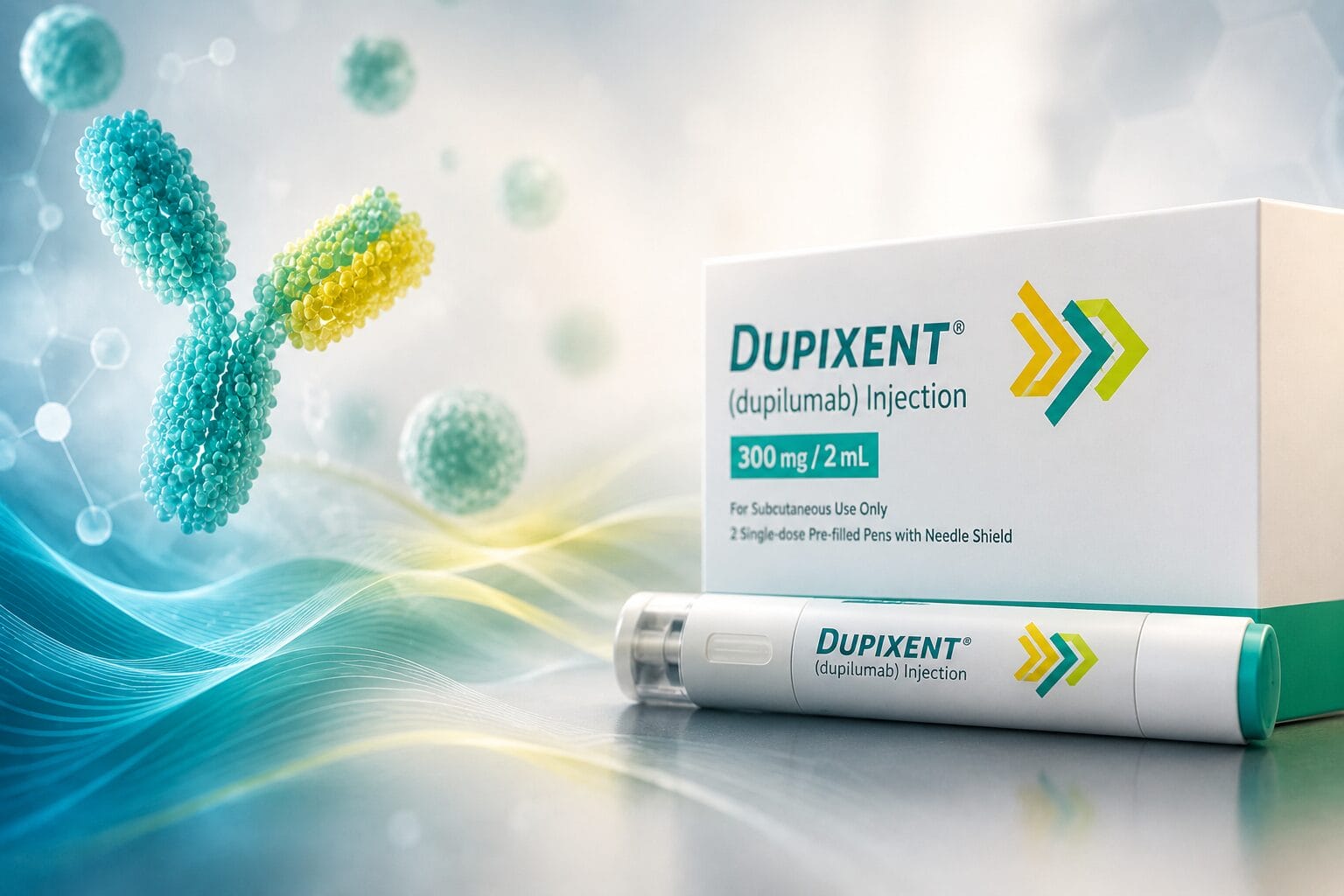
The Federal Dupixent Litigation Has Entered a New Phase
On June 4, 2026, the U.S. Judicial Panel on Multidistrict Litigation (JPML) centralized federal lawsuits alleging that Dupixent (dupilumab) caused, accelerated, or delayed the diagnosis of cutaneous T-cell lymphoma (CTCL). The litigation was transferred to the U.S. District Court for the District of New Jersey before Judge Zahid N. Quraishi for coordinated pretrial proceedings.
The transfer order identified 15 pending actions and seven potential tag-along actions from multiple federal districts. The court explained that common issues include scientific evidence, the adequacy of product warnings, and when the manufacturers allegedly became aware of potential risks.
MDL centralization is strictly a procedural mechanism. It does not establish liability, prove causation, or determine whether any individual claimant has a viable legal claim. However, it does provide plaintiff firms with a more structured framework for evaluating potential cases while public awareness of the litigation is likely to increase.
Before Launching a Campaign, Start With Intake
Generating inquiries is only one part of a successful mass tort campaign. The strongest campaigns begin with clearly defined qualification criteria, reliable medical screening, and operational workflows that allow attorneys to efficiently evaluate potential claims. Before increasing media spend, plaintiff firms should consider five key intake questions.
1. What Diagnosis Will the Campaign Accept?
The current federal litigation primarily involves plaintiffs who allege they developed CTCL after treatment with Dupixent. Many cases specifically involve mycosis fungoides or Sézary syndrome, two recognized subtypes of CTCL. While future filings could expand the scope of the litigation, campaigns built around broad references to ‘cancer’ or ‘lymphoma’ may produce significant inquiry volume with relatively few potentially qualifying claimants.
Initial intake should document the precise diagnosis, diagnosis date, treating physicians, pathology testing, CTCL subtype, and availability of medical records. Intake personnel should gather information rather than make medical or legal conclusions.
2. Can You Build a Reliable Exposure Timeline?
A diagnosis alone is insufficient. Intake should establish why Dupixent was prescribed, treatment dates, prescribing physician, dispensing pharmacy, symptom history, and whether symptoms predated treatment. Medical records, pharmacy records, and patient portals often become essential during later case development.
3. Can Screening Address Diagnostic Overlap?
Early CTCL can resemble eczema, psoriasis, and other inflammatory skin conditions. Researchers have discussed several possible explanations for the observed relationship between Dupixent and CTCL, including delayed diagnosis, disease unmasking, surveillance bias, and other competing scientific hypotheses. Current scientific literature has not established a definitive causal relationship.
Accordingly, intake should objectively document prior biopsies, symptom progression, physician observations, treatment response, and any changes that prompted additional evaluation.
4. What Documentation Is Needed Before Attorney Review?
Rather than focusing exclusively on cost per lead, firms should establish documentation thresholds for each stage of the intake process. Potentially relevant documentation may include pathology reports, dermatology records, oncology records, prescription histories, pharmacy dispensing records, biopsy reports, and treatment records. Performance metrics should emphasize verified medication exposure, preliminary medical screening criteria, attorney acceptance rates, and record completion rates.
5. Can Your Firm Support the Campaign Operationally?
Successful campaigns require trained intake personnel, condition-specific scripts, quality assurance, conflict screening, electronic authorizations, medical-record retrieval, attorney review protocols, secure handling of protected health information, and consistent claimant follow-up. Intake teams should also be prepared to respectfully explain when an inquiry does not meet current campaign criteria.
Building Around Evidence Instead of Volume
The creation of MDL No. 3180 provides a coordinated procedural framework for Dupixent litigation, but it does not resolve the scientific, medical, or legal questions that ultimately determine whether an individual claim has merit. The FDA has identified CTCL as a potential safety signal for continued evaluation while also explaining that inclusion on a safety-signal list does not establish that the medication caused the reported condition.
The strongest claimant acquisition programs are built around clearly defined injury criteria, reliable exposure timelines, objective medical-record screening, early documentation, attorney review, and continuous optimization. Firms that establish these standards before expanding advertising efforts are generally better positioned to reduce unqualified inquiries and focus resources on claimants whose records warrant further legal evaluation.
Build Smarter Dupixent Campaigns with Better Intake Intelligence
Launching a Dupixent campaign is about more than generating leads. Long-term success depends on identifying potential claimants who meet your firm’s screening criteria, collecting meaningful medical information early, and creating an intake process that supports efficient attorney review.
At SmashOrbit Legal, we help plaintiff firms build intelligent client acquisition systems that connect marketing, AI-assisted intake, human verification, qualification, and performance reporting into one streamlined workflow. Our focus isn’t simply generating more inquiries, it’s helping firms improve lead quality, optimize intake operations, and create scalable processes that support signed retainers.
Whether you’re evaluating a new Dupixent campaign or refining an existing one, our team can help you develop qualification criteria, improve intake workflows, optimize media performance, and build reporting systems that measure what matters, not just lead volume.
Ready to Build a Smarter Dupixent Campaign?
If your firm is exploring the Dupixent litigation, let’s discuss how a data-driven acquisition strategy can help improve intake quality while keeping your team focused on the claimants who warrant further legal review.
Schedule a strategy conversation with SmashOrbit Legal to learn how we help plaintiff firms build intelligent client acquisition systems designed for today’s evolving mass tort landscape.