
The FCC’s one-to-one consent rule was one of the most closely watched developments in lead generation and telemarketing compliance. For legal marketers, it raised a direct operational question: would comparison sites, intake funnels, and lead vendors need to obtain separate consent for each individual firm or seller before a call or text could be sent?
In January 2025, the U.S. Court of Appeals for the Eleventh Circuit vacated Part III.D of the FCC’s 2023 Order. That was the portion of the order that would have required consent to be given to only one identified seller at a time and would have required the resulting calls or texts to be “logically and topically associated” with the interaction that prompted consent. The court held that the FCC exceeded its statutory authority because the added consent restrictions conflicted with the ordinary statutory meaning of “prior express consent.”
For law firms and legal marketing teams, the key takeaway is not that compliance can loosen. The better takeaway is that one federal rule was vacated, while the broader TCPA and consumer-protection framework remains very much alive.
What the vacatur changed
The FCC’s 2023 Order was aimed in part at what the agency called the “lead generator loophole.” The agency said it wanted to prevent lead generators, texters, and callers from relying on a single consumer consent to trigger unwanted calls and texts after a consumer visited a comparison-shopping website.
The Eleventh Circuit’s decision means that the specific one-to-one consent and “logically and topically associated” restrictions in Part III.D are no longer in effect. The court described the challenged rule as imposing two categorical limits: consent from only one entity at a time, and consent only for calls whose subject matter matched the interaction that produced the consent. The court then vacated that portion of the order and remanded the matter for further proceedings.
That matters for legal marketers who work with multi-buyer lead flows, co-registration funnels, comparison-shopping experiences, or third-party intake networks. But the vacatur should not be treated as a green light for vague disclosures, sloppy vendor practices, or broad consent language that the consumer would not reasonably understand.
What did not change
Legal marketers still need to account for the TCPA and FCC rules governing calls and texts. The current FCC rule continues to restrict calls made with an automatic telephone dialing system, artificial voice, or prerecorded voice to certain numbers without the called party’s prior express consent. For telemarketing or advertising calls using those technologies, the rule still requires prior express written consent.
The FCC’s rules also continue to cover text messaging in important ways. In the 2023 Order, the FCC reiterated that its TCPA framework treats certain text messages as calls for these purposes, and it codified that National Do-Not-Call Registry protections apply to text messages.
The revocation rules are also critical. Under the current FCC rule, a consumer may revoke prior express consent, including prior express written consent, using any reasonable method that clearly expresses a desire not to receive further calls or texts. The rule identifies words such as “stop,” “quit,” “end,” “revoke,” “opt out,” “cancel,” and “unsubscribe” as reasonable means of revocation when sent in reply to an incoming text. It also requires revocation requests made in any reasonable manner to be honored within a reasonable time, not to exceed ten business days.
What legal marketers should still do
1. Keep consent clear, conspicuous, and specific
Even without the one-to-one rule, consent language should not be buried, vague, or disconnected from the consumer’s actual request. A consumer looking for help with a potential mass tort claim, personal injury case, disability claim, or other legal matter should understand who may contact them, why they may be contacted, and what communication methods may be used.
For legal marketing, that means consent disclosures should identify the relevant category of legal services, the potential contacting parties or partner network where appropriate, and the communication channels involved, such as calls, texts, prerecorded messages, or automated technology. The goal is not merely to satisfy a technical standard. The goal is to create a record that a consumer knowingly agreed to the outreach.
2. Preserve the consent record like evidence
If a TCPA dispute arises, the most important question may not be whether a checkbox existed. It may be whether the firm, vendor, or platform can prove what the consumer saw and did at the time consent was collected.
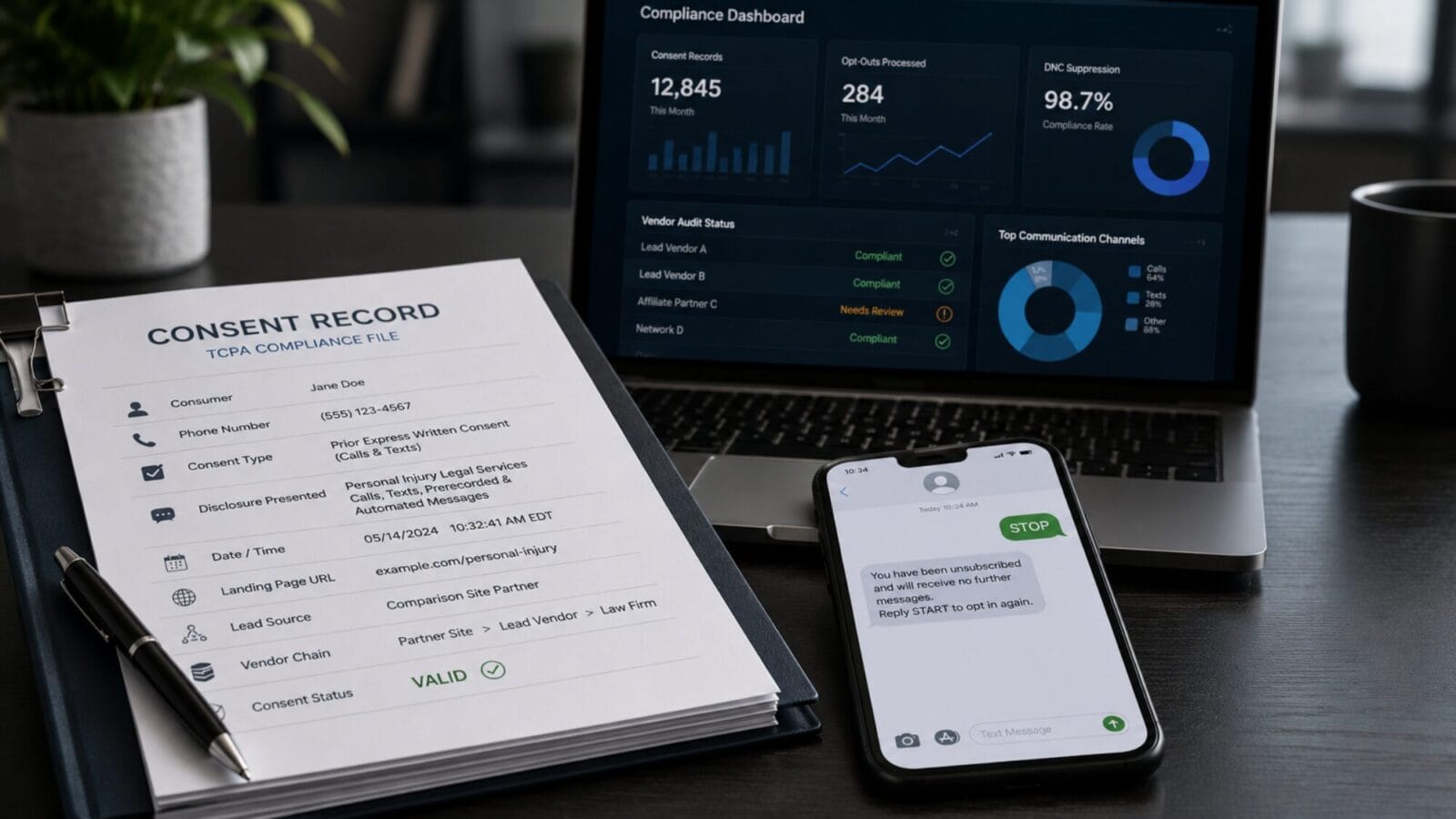
Legal marketers should maintain timestamped consent records, IP address or session data where appropriate, form version, landing page URL, disclosure text, consumer-submitted phone number, lead source, vendor chain, and any transfer history. If a lead passes through multiple vendors, the receiving firm should be able to trace the consent path rather than relying on a generic vendor assurance.
3. Audit vendors and lead sources
The vacatur does not eliminate the need for vendor governance. Law firms should still ask lead partners how consent is collected, how disclosures are displayed, how opt-outs are processed, how calls and texts are suppressed, and how records are retained.
This is especially important for high-volume legal campaigns where leads may be generated through affiliates, comparison sites, paid social, search, display, or co-registration paths. If a vendor cannot show the consumer-facing consent experience and the supporting data trail, the law firm may be inheriting risk it cannot evaluate.
4. Build fast, reliable opt-out workflows
Revocation is now one of the clearest operational risk areas. Legal marketers should treat “STOP” and similar opt-out language as compliance-critical data, not as a marketing preference buried in a platform.
A strong workflow should suppress the number across campaigns, vendors, intake queues, CRM automations, and texting tools. It should also account for less formal revocation requests, because the FCC rule recognizes any reasonable method that clearly communicates the consumer’s desire to stop receiving calls or texts.
5. Keep DNC compliance separate from consent strategy
Consent and Do-Not-Call compliance should be managed as related but distinct obligations. The FCC’s rules restrict telephone solicitations to residential subscribers who are on the National Do-Not-Call Registry, subject to rule-based exceptions and safe harbor conditions.
For legal marketers, this means list hygiene remains essential. Firms should maintain internal suppression lists, vendor-level suppression requirements, and campaign-level checks against applicable DNC obligations. Do not assume that a lead form alone resolves every DNC issue.
6. Match outreach to consumer intent
The vacated rule’s “logically and topically associated” requirement is no longer operative as a categorical FCC restriction, but it remains a smart risk-control principle. If a consumer requests information about a specific legal issue, outreach should stay tied to that request.
For example, a consumer who submits a form about a potential product liability claim should not receive unrelated marketing texts about an entirely different legal service unless the consent language and user experience clearly support that outreach. Relevance reduces complaints, improves intake quality, and supports a more defensible consent story.
7. Review scripts, SMS copy, and intake handoffs
Compliance does not stop at the landing page. Call scripts, SMS templates, intake handoffs, and transfer disclosures should align with the consent obtained. Teams should review whether messages identify the firm or campaign clearly, avoid misleading urgency, provide opt-out instructions where appropriate, and avoid outreach after revocation.
This is especially important when a firm uses outsourced intake or appointment-setting teams. The consumer experience should feel consistent from ad click to form submission to call or text follow-up.
The practical bottom line
The FCC one-to-one consent rule was vacated, but legal marketers should not confuse that outcome with a lower standard for consumer consent. The safer path is still to make consent clear, preserve the record, govern vendors, honor opt-outs quickly, maintain DNC controls, and keep outreach tied to the consumer’s stated legal need.
SmashOrbit Legal helps law firms think about growth systems with both performance and risk in view. We are a complete client acquisition partner with decades of experience from top plaintiffs firms and Fortune 500 brand advertising, using AI analysis to continuously refine channels and optimize campaigns so firms can pursue more consistent volume of higher qualified claimants.
Contact Us Today!