
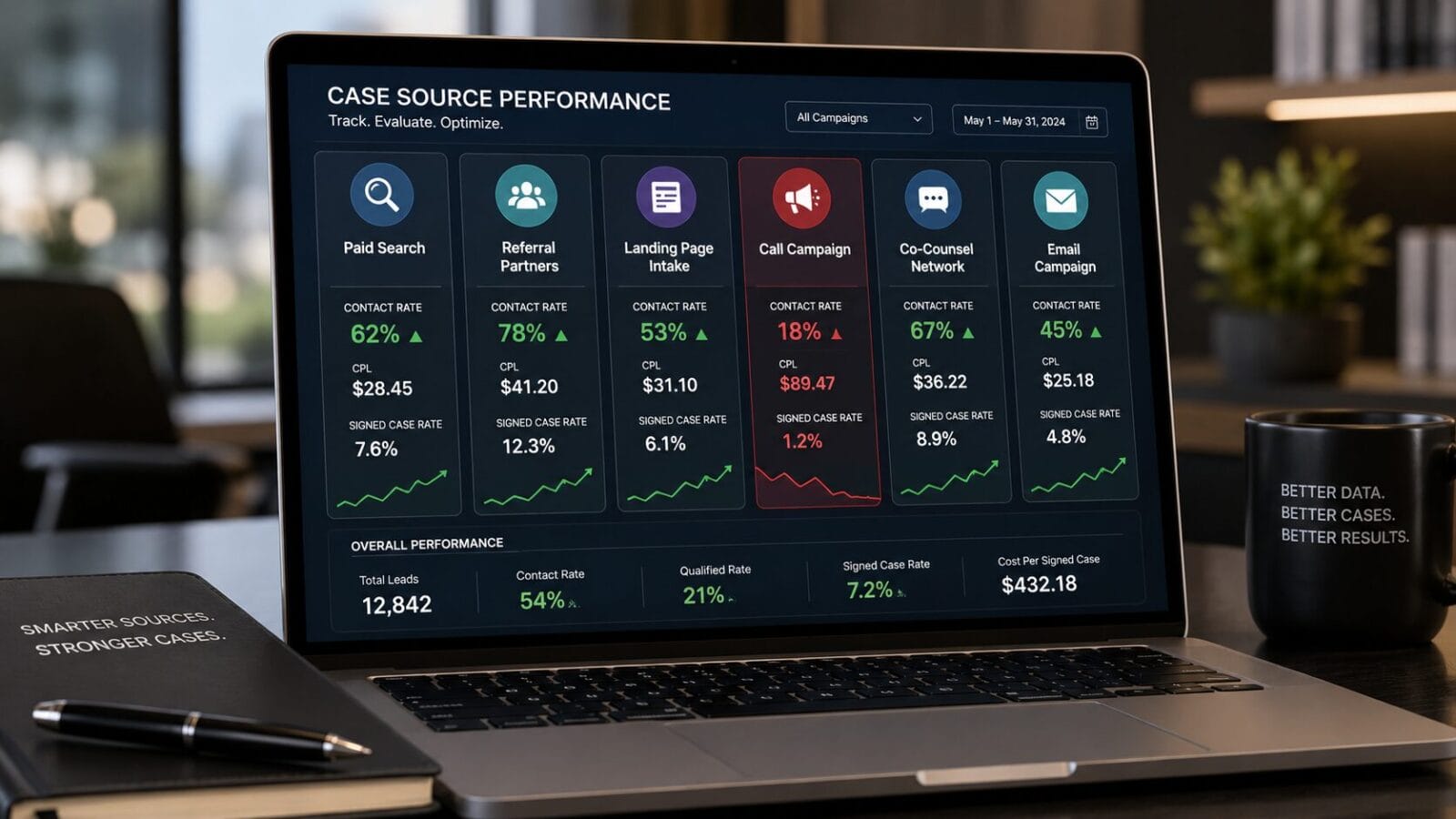
For mass tort and plaintiff firms, case acquisition is not just a marketing expense. It is a pipeline investment. Every paid lead source, referral partner, call campaign, co-counsel relationship, and digital intake channel should be evaluated by the same core question: is this source producing qualified, reachable, legally relevant potential claimants at a cost the firm can justify?
The challenge is that underperforming case sources rarely announce themselves right away. A campaign may look strong on volume while quietly draining intake capacity. A vendor may deliver forms that appear compliant on the surface but produce poor claimant fit. A referral stream may generate activity without producing signed, viable cases. By the time the problem shows up in cost per signed case, the firm may already have spent weeks or months of budget.
The better approach is to spot weak source signals earlier.
Volume Is Not the Same as Value
One of the most common mistakes in legal lead generation is overvaluing raw lead count. High volume can be useful, but volume without quality can become expensive noise.
For mass tort campaigns, the firm should look beyond how many leads were delivered and ask:
- How many leads were actually reached?
- How many completed intake?
- How many met the core case criteria?
- How many were already represented?
- How many were duplicates?
- How many converted into signed cases?
- How many were rejected after deeper review?
A source that delivers fewer total leads but produces better contact rates, cleaner data, and stronger qualification may be more valuable than a source that fills the intake queue with unqualified prospects.
Early Warning Sign #1: Poor Contactability
A weak case source often reveals itself through contactability before it shows up in final conversion metrics.
If the phone numbers are bad, the emails bounce, prospects do not remember submitting information, or call attempts consistently go unanswered, the problem may not be your intake team. It may be the source.
Mass tort firms should track contactability by source, not just across the entire intake operation. A firm may have a healthy overall contact rate while one source is quietly producing low-quality or stale inquiries. That source-level view helps prevent good campaigns from masking bad ones.
Key metrics to monitor include:
- Valid phone number rate
- Valid email rate
- First-call connection rate
- Contact within the first 24 hours
- Number of attempts needed to reach the prospect
- Percentage of leads who deny interest or do not recall submitting a form
When these numbers trend poorly, the firm should pause and investigate before increasing spend.
Early Warning Sign #2: Qualification Mismatch
A source can look productive while still failing the legal criteria that matter most.
In mass tort marketing, qualification mismatch can include leads involving the wrong product, wrong injury, wrong timeframe, wrong jurisdiction, wrong exposure history, or prior representation that makes the lead unusable. If the campaign is built around a specific litigation, small targeting errors can create a large amount of wasted intake labor.
Firms should compare each source against a written qualification profile. That profile should be specific enough to help intake teams and marketing partners evaluate the same standard.
A practical source scorecard might include:
- Relevant product or exposure
- Injury or diagnosis match
- Date-of-use or exposure window
- Treatment or documentation indicators
- Representation status
- Jurisdiction or venue considerations
- Statute-of-limitations risk indicators
- Completeness of intake information
When a source repeatedly misses the same criteria, the firm should not simply ask for more leads. It should revisit the targeting, intake script, landing page language, vendor criteria, or referral instructions.
Early Warning Sign #3: Duplicate and Recycled Leads
Duplicate leads can distort performance reporting and inflate the perceived value of a source. A duplicate may appear to be a new opportunity when it is really a repeated contact, a recycled database record, or a claimant already in another campaign.
For mass tort firms handling multiple campaigns, duplicate tracking is especially important. A claimant may enter through several vendors, forms, or advertising paths. Without source-level deduplication, the firm can end up paying more than once for the same person.
Every firm should track:
- Duplicate rate by source
- Duplicate rate across campaigns
- Duplicate rate by phone and email
- Prior-contact history
- Prior-representation indicators
- Whether the duplicate was exclusive, shared, or resold
A rising duplicate rate is a signal to review vendor terms, lead exclusivity, attribution rules, and data hygiene.
Early Warning Sign #4: Intake Time Is Increasing Without Better Outcomes
Bad sources do not only waste media budget. They also consume intake capacity.
If one source requires more call attempts, more manual clarification, more document chasing, and more attorney review while producing fewer signed cases, its true cost is higher than the invoice suggests.
This is why firms should measure both marketing cost and operational cost. A source that appears inexpensive on a cost-per-lead basis may become expensive once staff time is included.
Useful operational metrics include:
- Average intake time per lead
- Number of call attempts per completed intake
- Percentage requiring manual correction
- Percentage requiring attorney review before rejection
- Document collection rate
- Signed-case rate after full screening
A source that strains the intake team without improving case quality should be re-priced, restructured, paused, or eliminated.
Early Warning Sign #5: Weak Source Transparency
Law firms should know how a case source is generated, what claims are being made to prospects, how consent is captured, and whether the data is exclusive, shared, aged, or transferred through multiple intermediaries.
This matters for performance, but it also matters for risk management. Lead-generation ecosystems can involve multiple parties, data transfers, and aggressive follow-up practices. Recent public research into lead marketing has highlighted concerns around sensitive data sharing, rapid consumer contact, and unclear brokerage practices in some lead-generation environments.
For law firms, the practical takeaway is straightforward: do not evaluate a source only by price and volume. Evaluate the source’s collection process, consent language, data path, and quality controls.
Questions to ask include:
- Where did the lead originate?
- What form or landing page did the prospect see?
- What language explained who would contact the prospect?
- Was the lead exclusive or shared?
- Was the lead generated in real time or purchased from an older database?
- Were any third parties involved in collection, transfer, or follow-up?
- Can the vendor document consent and source details?
- Are advertising and intake representations consistent with applicable legal ethics rules?
A vendor that cannot answer these questions clearly may create more risk than value.
Early Warning Sign #6: Cost Per Signed Case Is Moving in the Wrong Direction
Cost per lead is easy to track, but cost per signed case is usually more meaningful.
A firm should review source performance through the full funnel:
- Spend
- Leads delivered
- Leads reached
- Intakes completed
- Qualified prospects
- Retainers sent
- Signed cases
- Cases accepted after review
- Cases that remain viable over time
This full-funnel view can reveal hidden waste. For example, a source may have a competitive cost per lead but a weak contact rate. Another may produce qualified prospects but low signed-case conversion. Another may sign cases that later fail documentation review.
The goal is not to punish every source for every drop-off. The goal is to identify where the drop-off occurs so the firm can fix the right problem.
Build a Source Review Cadence
Source quality should not be reviewed only after a campaign ends. Firms should create a review rhythm that allows them to intervene early.
A practical cadence might include:
- Daily monitoring for contactability and duplicate issues
- Weekly review of intake completion and qualification trends
- Biweekly source scorecards for active campaigns
- Monthly budget reallocation based on signed-case and accepted-case performance
- Post-campaign review to compare projected value against actual outcomes
The faster a firm can see source-level performance, the faster it can protect budget.
Use a Red-Yellow-Green Scoring System
A simple scoring model can help attorneys, intake leaders, and marketing teams make decisions quickly.
Green sources produce reachable, qualified, timely, well-documented prospects at a sustainable cost.
Yellow sources show mixed results and need adjustment, such as better targeting, revised intake questions, clearer vendor expectations, or tighter budget limits.
Red sources show repeated quality problems, poor transparency, high duplication, low contactability, or unacceptable cost per signed case.
This structure gives the firm a shared language for deciding whether to scale, monitor, fix, or pause a source.
What to Do When a Source Underperforms
When a source starts to underperform, the first response should not always be cancellation. Sometimes the issue is fixable.
Before cutting the source entirely, firms should consider:
- Tightening campaign criteria
- Revising intake questions
- Requiring better consent documentation
- Adjusting geographic or claimant filters
- Renegotiating pricing based on quality
- Pausing spend while reviewing a sample of leads
- Comparing the source against signed-case outcomes, not just intake volume
However, if a source cannot provide transparency, repeatedly misses qualification criteria, or consumes intake resources without producing viable cases, the firm should be willing to stop spending.
The Bottom Line for Mass Tort Firms
Underperforming case sources are not always obvious. They often hide behind attractive lead volume, low headline pricing, or short-term activity. Mass tort firms that want to protect budget need source-level visibility into contactability, qualification, duplication, transparency, intake burden, and signed-case performance.
The strongest firms treat lead quality as a management system, not a guess.
SmashOrbit Legal helps plaintiff firms evaluate and improve client acquisition with a practical blend of law-firm experience, brand advertising discipline, and AI-informed performance analysis. If your firm wants to better understand which case sources are helping growth and which ones are quietly wasting budget, message us or click the link below to start the conversation.